- Diligence - never giving up in work, love, life.

The Virtual School of Romance

Dionysus Instinct
Dionysus is the god of the grape harvest, winemaking and wine, of ritual madness, fertility, and theatre. He is a god of epiphany, "the god that comes", and his "foreignness" as an arriving outsider. He is the only god born from a mortal mother, and his festivals were the driving force behind the development of Greek theatre. His Roman name was, Bacchus, origin of the word, "bacchanalia," or a grandiose celebration, and so he represents the instinct for passion in males, at being recipients of good fortune and unanticipated discovery, the thrill for men, of being the "new kid on the block," and throwing one's self into social randomness, to discover in fortunate accidents, that it really is true: "The world is your oyster." His is the power of the masculine instincts to rise in social standing through being "the life of the party," and "master of ceremonies."
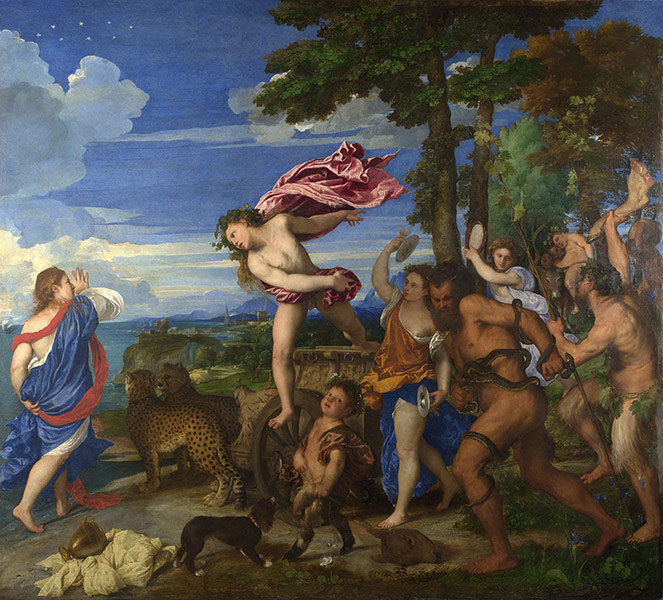 He is flamboyant, and shamelessly sexual, and in terms of the constructs of Romantic Dynamics, one could say that he has unlimited confidence and charisma both, but that the source of those, comes from the power of "working a crowd, rather than what you might call, "quiet confidence." This is no matter to him, and one of the reasons that men hunger for the vitality of this instinct, possibly to the disdain and heckling of those who do not understand its merits. Because he is free, by his own will, to be as politically incorrect as it gets.
The word for this state of being is "shameless," which gives some pause to define the word as somehow, "shameful," when in fact it means, "fully alive" in our parlance. Shame is the opposite of passion, and in this case, masculinity. And so to be "shameless" is to usurp the external forces that take away the vitality, robbing life of life. His way is to forge masculinity purely by the power of the will to celebrate, to declare an identity of jubilation, and to win the crowd to the same, celebratory feeling. To "feel lucky," and in so doing, discover that one may "make his own luck" through being his own publicist and testimonial to the "good life."
This instinct is different than that of the Narcissus Instinct, in that it contains a skill and a cleverness that belies the fact that in making others happy through celebration, that there is power worth celebrating in simultaneously raising one's own social rank.
We have learned of that desire in men within the Zeus Instinct - to know one's rank and then to desire its elevation through leadership. This is an alternative way to do so through giving others what they want, rather than what, from a leader's perspective, "what they need." His procession is made up of wild female followers and the god himself is drawn in a chariot, usually by exotic beasts such as tigers. His is a "cult" for the followers of his Dionysian Mysteries. He is the master marketer, the P.T. Barnum of his own circus. In today's language, he "knows how to grow a posse."
Dionysus is the son of Zeus and the mortal Semele, both fully divine, and also human. Zeus's wife, Hera, discovered the affair while Semele was pregnant. Appearing as an old crone, Hera befriended Semele, who informed her that Zeus was the actual father of the baby, causing Semele to demand that Zeus reveal himself. Since a mortal could not look at the face of a god without dying, and she perished in a tower of flame. Zeus rescued the unborn Dionysus by sewing him into his thigh, thus his name, meaning "twice-born".
Dionysus is the male instinct of feeling like "being born again," a feeling of celebrity, fame, and luck that one crafts for one's self.
RETURN TO THE MASCULINE INSTINCTS
Disarray
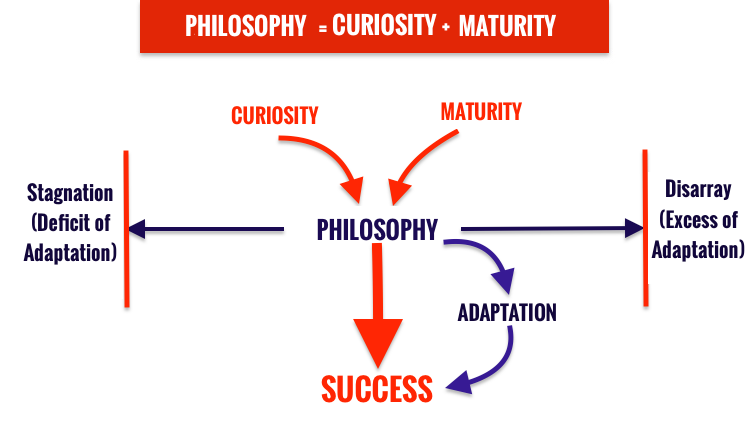 Disarray is an excess of adaptation to the world around us, and adaptation is a major gift of the virtue of Philosophy. And so Disarray is the excess of Philosophy. A person who is "all over the map" in terms of how they approach goals. It's hard to get to any of them if there are too many of them.
Philosophy as a virtue, is composed of curiosity and maturity, and so the excess of it turns us toward a kind of voracious curiosity that actually is detrimental and immature to ever getting to our goals. Whereas the virtue of Philosophy in its curiosity contributes to us being adaptable to the changes in our environment by seeing challenges coming our way and seeing the possible strategies to solve them, the maturity in our philosophy also causes us to be adaptable by actually having the psychological balance and resources to solve those challenges. As a result, Disarray is harmful to the individual, and to the relationship, in its pathological narcissism and immaturity.
RETURN TO CHARACTER COMPATIBILITY
Displacement
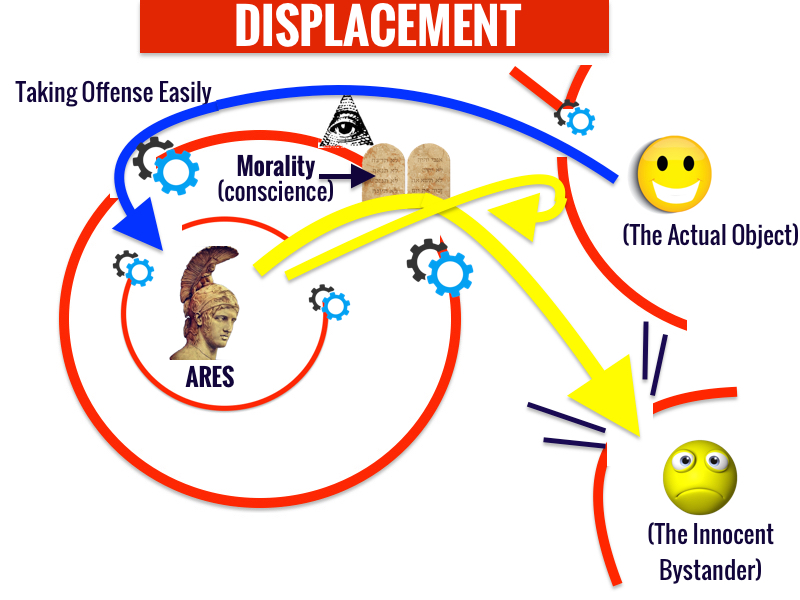
Whenever you are in a relationship and are inexplicably getting blamed for something you didn’t do, it is very likely that this social habit is going on, especially if there is a “triangle” of relating.
For example, 1. you, 2. her, and 3. grandpa, or 1. you, 2. him, and 3. junior, or 1. you, 2. him, and 3. his boss, or 1. you, 2. her, and 3. her best friend.
Displacement occurs when, in the above, grandpa is dying of cancer, she is unconsciously furious at him for dying, and she is suddenly angry at you being five minutes late for visiting hours because you stopped at the gift shop to bring something nice up to the room.
Or when your son soiled his pants so badly in the church pew that it seeped out around the lining, and onto a hymnal, now you’ve got it on yourself and she is absolutely livid at you for not having tracked his bodily functions right before the service started.
Or when he comes home from work after the boss fired him (and rehired him) for the third time this month, and he barks at you why the heating bill is still sitting on the counter, since it should have been mailed this morning.
Or what it is like when her best friend (who’s recently broken up) is still sleeping on your living room couch two weeks after the breakup, only this particular evening, she has gone out on the town, returned home with jangling keys to the point of waking up the whole household, and must have vomited at some point because the couch definitely smells like that in the morning. You arise to find them sitting on the couch together in the morning, and ask, “What happened last night?” At which your mate jumps all over you and asks how you could dare ask that question.
What’s in common in all these stories of unexplainable anger at someone who did nothing wrong, and does not deserve to hear any blame, is that the real object of discontent is somehow “off limits” to vent that anger on - grandpa, who’s dying, the son who didn’t know any better, the boss, who pays the paycheck, or the best friend, who is a victim of a failed love. Since none of these culpable parties are acceptable targets of our ire, we let off the pressure on a third party, a bystander, but perhaps someone with whom we have other gripes or enough intimacy to intuit that at some level, they will help us process our feelings.
Call it, “Kick the Dog Syndrome,” as in the man who returns from a hard day of frustration at work, and kicks the dog out of the way in wrongful spite, collateral damage in his bad day, and certainly a cruel thing to do.
It is a social habit very rampant in families, where there is already a natural openness to intimate communication and emotional expression. Yet, when one or more members of the family has a great amount of work to do on their personal boundaries, a habit of displacement can abound.
This defense mechanism shifts sexual or aggressive impulses to a more acceptable or less threatening target. You might say that it “lets off steam on a safer target, in order to avoid directly addressing what is frightening or threatening - the death of grandpa, public embarrassment in church, being fired from work, or losing a best friend who disrespects your generosity.
GO BACK TO NEUROTIC DEFENSE MECHANISMS.
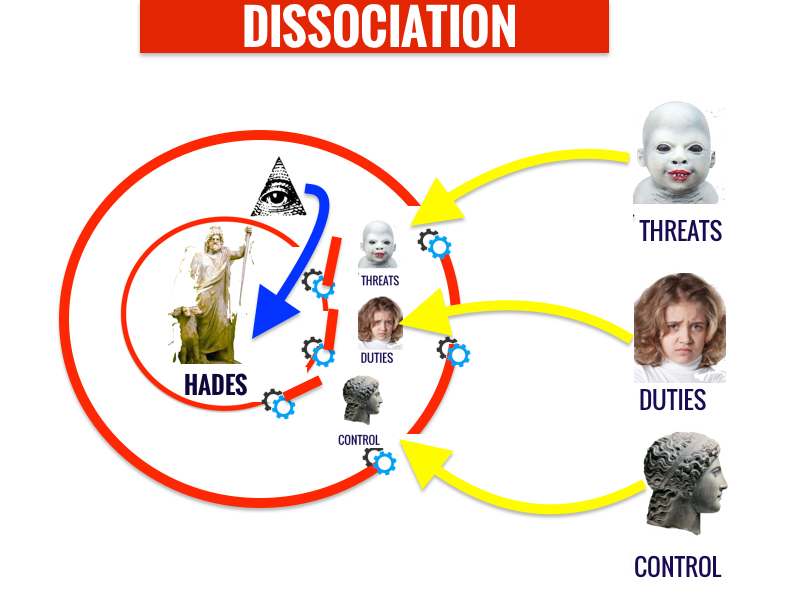
Dissociation
This social habit is more than just ‘zoning out,” since it involves utterly losing touch with one’s sense of personhood for a time, to separate the experience of trauma, attack or anxiety on that personhood, a bit like getting up and leaving a room in which there is an argument going on, only the room is you.
The habit also can be done when one just separates or clamps down on an emotion to the point where it is not felt for now, so that one can deal physically or intellectually with matters at hand. It’s the “I don’t have time to cry” habit, and you might see how much it offers as a survival tool socially when under times of extreme stress or threatened trauma.
It is “burying your head in the sand” so that the social threat at hand, may eventually diminish. Similar to the Biblical quote, “This too, shall pass,” it does more: it is going on a vacation from your experience of self so that you may reemerge with the threat or trauma physically long gone.
GO BACK TO NEUROTIC DEFENSE MECHANISMS.
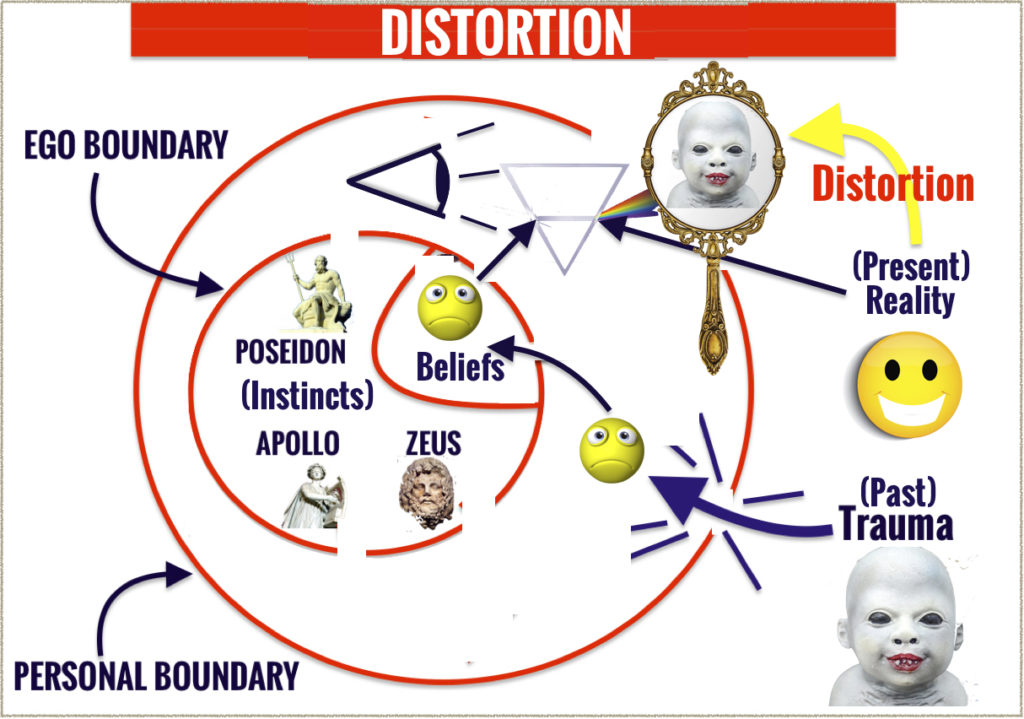
Distortion
A gross reshaping of external reality to meet internal needs. This one is definitely worth noting and mentioning because it is so often used among couples in their communication. In that context, what is most often meant by it is to say that the other person is not interpreting us properly in communication. As you may guess, it is hard to overcome, and as you could imagine, is not compatible with a long-term relationship. A film where this is seen is Woody Allen’s, Match Point, in which an American woman currying favor with a wealthy family is interrupted by the local soccer pro, and Falls on love with disastrous consequences.
Distortion is much like a funhouse mirror, in which, rather than looking directly at an object or person (as one would naturally be doing by being directly communicative with their partner, using good boundaries, the person unconsciously goes about looking indirectly at reality as through a damaged prism (or funhouse mirror). That “prism” or “mirror” likely is formed and shaped by our history, and all the things that have happened in our lives to shape our beliefs about the world. So, in essence, when we are immature and using this defense mechanism, we are unconsciously looking at our own history and the beliefs it formed, rather than interacting with and testing reality directly.
BACK TO PRIMITIVE EGO DEFENSES