

Men feel shame. So do women. They feel it for different reasons and express it in different ways. Trauma that drains the masculinity in men is felt by them as shame, the loss of "life essence" and dignity. Trauma that drains the femininity in women is felt by them as shame, the loss of "life essence" and dignity.
Shame from trauma to the core essence of a person, their dignity, humiliation at past times of life is what causes men and women to fight with each other more than anything else. A couples' quarrel is always trauma talking to trauma, much of which isn't even from their history with each other.
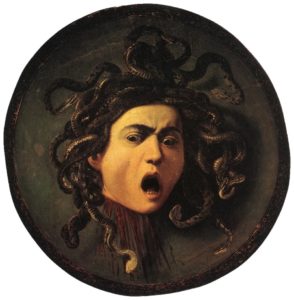
The myth of Medusa is very instructive on the nature of feminine shame that blocks any chance of teamwork, partnership, love, attraction, femininity and masculinity in the relationship. It is culturally most opposed and represented in the sociology of third-wave feminism and beyond or any cultural movement led by the hatred of and rage against men in general.
The Jungian psychology of Medusa and themes related to narcissistic abuse, emphasize the interplay between archetypes, gender dynamics, and psychological trauma.
In his chapter, Jungian psychologist James Hollis explores the archetype of Medusa as a symbol of feminine power and transformation, particularly regarding the experience of being objectified or abused. Hollis connects the Medusa myth to the emotional suppression and psychological trauma often faced by women, drawing parallels to the experience of narcissistic abuse where women may feel trapped in a cycle of victimization.1
We need to begin to obtain an understanding the Jungian implications of Medusa as an archetype and its relation to themes of narcissistic abuse.
We must remember that we are talking about how to get two people into a passionate, loving, successful partnership, not a competition between two people to win some sociological battle. If you don't want to be desired, loved, or teamed up with for success, don't bother to read this lesson and instead indulge in whatever you think will make you happy.
Shame and rage won't lead to happiness though, only revenge perhaps, and always followed by despair.
One article examines the impact of narcissistic mothers on their daughters through a Jungian lens. It discusses how these relationships can lead to internalized trauma and self-objectification, paralleling the experience of Medusa as a figure who embodies the fear and destructive aspects of the feminine when subjected to narcissistic control.2
The incitement of shame or rage in others is only likely to deplete you of outside social resources and the avoidance of others.
If you recall the very first myth that we covered about initial attraction and dating—The Judgment of Paris—then you may recall that the inciting incident that started the contest between the goddesses was when Eris, goddess of discord, was not invited to the party of Zeus and Hera on Mt. Olympus.

Like her name's meaning, she introduced discord to the party anyway in the form of a golden apple that incited envy among the goddesses.
The Medusa Instinct is far worse, like the Eris Instinct on steroids, since it may spill over into discord among former friends but is far worse than mere envy. Instead, it is a force of wonton, open destruction and rage rather than cleverly concealed envy.
Here we need to introduce the topic of Female Shame and what it does to love and relationships. By definition, shame is a depletion of the "life force" or vitality in masculinity or femininity. In this case it is depleted femininity turned to rage, then directed at the depletion of masculinity in any and every random male she encounters.
In one's social circle this would then lead to rage being returned to the person who spreads it, and to utter destruction of the passionate base a partnered couple needs to both have an ongoing sex life, and the energy to achieve one's dearest personal life's goals and relationship goals.
For us to solidify the lessons of a woman helping herself rid herself of shame (and the man assisting in this for her too), we needed to learn the story of Medusa.
There will be a link between our prior story of Theseus and Ariadne, Medusa and Perseus, and finally Psyche and Aphrodite. These three cover an entire spectrum of feminine development showing balance in the middle (Ariadne), severe narcissism and destructiveness (Medusa), and finally, the growth (Psyche) that leads out of narcissism and into balance again (Ariadne.)
Just as Ariadne had to help Theseus from afar in his pursuit of victory over the Minotaur of the workplace, there is symmetry in the man needing to help the woman from afar as she learns the lessons of mature feminine power seen in the eventual story of Psyche and Aphrodite yet to come.
For now, we need to see the face that turns men to stone to this day so that we can explore the deepest spaces of narcissism, trauma, despair, and rage in women, in Medusa.3
SPREADING THE SHAME IS NOT ATTRACTIVE
- Medusa and Female Shame
- Trauma Talking to Trauma is The Source of All Discord
- Intellectual Attraction Fails Without Perseus in the Man
- Women's Trauma Healed Through Words of Apology and "Just Listening"
- The Tools of Perseus in "Getting the Ugliness Out"
- Beheading the Narcissism, With the Decisive Sword of Zeus
WHAT IT MEANS:
- 1 The traumatized female carries shame, a depletion of femininity in passion for life and love.
- 2 Shame transmutes to rage when left no healing of trauma, which destroys relationships through words and actions.
- 3 The only healing of shame is to block the Medusa Instinct in women with the "shield of Perseus" that represents a Personal Boundary, a task given to the man to execute, allowing the woman's trauma to heal without having to actually be her therapist.
Medusa and Female Shame
Everyone has opinions on the sexes, and some may lump half the planet into one category they then may disdain or even spew rage on. But doing so is only projecting out on others one's own feelings of shame.
We have described shame as either a diminishment of masculinity or femininity. Prior to that we described both masculinity and femininity as synonymous with what Freud called "Libido," or "life force." The Chinese Medicine practitioners might call it "Xi" but the rest of us call it "vitality" or "exuberance" or "charisma."
When you have plenty of it, there is overflow enough to give it to others via your charisma.
When it is in short supply, you might react reflexly avoiding any perceived sleight from others with a bit of a paranoia.
When it is in severe deficit, one slips into a mood state that has been called "dysthymia" or "melancholia"—a difficult to shake illness that is resistant to standard psychotherapies and medicines.
Consider the near-absence of masculinity or femininity to be called "humiliation" or an utter loss of dignity as a person, such that the feeling of shame feels like a "little death" or the absence of life and vitality.
Shame is then like a "vacuum" of life, which can be spread on others in ways that tries to fill up its chasm of emptiness, a hunger that can never be fully satisfied, a thirst that can never be quenched.
The hunger and thirst of shame looks at others and sucks the life out of them in envy, and Medusa is our ultimate representation of the feminine version of this.
Medusa is in may ways similar to a Hindu goddess, who swallows food only for it to come right out of her stomach. She represents the void that existed before creation and does after every deterioration and crumbling in life.
Medusa is a "vacuum" of life itself, and by turning men to stone, becomes lifeless. As the story goes:
The mythical tale of Perseus and Medusa chronicles the journey of Perseus, a hero with divine lineage, and his perilous encounter with the monstrous Gorgon Medusa. This narrative is replete with adventure, heroism, and supernatural beings, all of which contribute to its enduring popularity and profound symbolism of feminine shame and ways to dispel and heal it.
Perseus, the son of Zeus, the king of the gods, and Danae, a mortal princess, was born under extraordinary circumstances. Fearing a prophecy that predicted her son would cause her father's demise, King Acrisius, Danae's father, locked her in a tower.
Yet, Zeus found a way to visit her in the form of a golden rain and impregnated her with Perseus. Eventually, Acrisius discovered the existence of his grandson and cast Danae into the uncertain sea with the infant Perseus in a wooden chest.
Miraculously, the chest arrived safely on the island of Seriphos, where Dictys, a fisherman, welcomed Perseus and his mother. Perseus grew up under his care, honing his skills in combat and becoming a formidable warrior.
However, the treacherous King Polydectes desired Danae and sought to marry her. Perseus saw this as an opportunity to prove himself and accepted Polydectes's quest: slay Medusa, the most infamous Gorgon whose glance could turn any living thing to stone.
In another origin story, Medusa is a young maiden who the god Poseidon raped in the temple of Athena. Medusa was shamed and enraged by this ultimate violation of the physical body and feminine spirit, exacerbated by Athena's absence from coming to her aid.
In consolation, Athena turns Medusa's hair into writhing snakes, and her monstrous visage then has the power to turn men to stone (to shame them and turn them to a form devoid of life, as a statue.)
Thus, Medusa had the power to eternally dispel her shame in the form of rage at others who shame them instead.
Our only problem with this as humans is that shame dispensed as rage only serves to speed shame and rage among the populous and in our relationships.
The Gorgons were monstrous creatures with snake-like hair, fangs, and terrifying visages. They were three sisters, Medusa being the only mortal among them. Armed with his divine heritage, Perseus embarked on his harrowing quest, aided by the gods Athena and Hermes.
They provided him with a polished shield, enabling him to see Medusa's reflection rather than directly face her, and winged sandals for swift movement. This represents the universal protective power of a person using their personal boundary.
Traversing perilous lands and facing numerous challenges, Perseus ultimately arrived at the cave where Medusa resided. Cautiously using his shield as a mirror, he beheaded the fearsome creature, careful not to gaze directly at her petrifying visage.
In other words, by blocking her unjust rage on him, he lets her project it everywhere else, revealing her as a monster and defeating her via her destructiveness being revealed to society at large.
"Beheading her" is only symbolic of her inherent, destructive mode of behavior, not fit as a mother, wife, sister, friend or member of society. It is a similar story to that of vampires being defeated by mortals, dying to their monstrous selves, and revealed as a traumatized person worthy of society's protection, safety, and space to heal.
To return to the world of the living, like one hopes to do for vampires in vampire myths.
The moment of Medusa's demise unleashed the birth of another mythical being: the flying horse Pegasus, who sprung forth from her severed neck. This symbolizes the healing of feminine trauma through boundaries interactions with a man, free to fly through the air, free of trauma at last.
Having accomplished his mission, Perseus began his journey back.
Along the way, he rescued the princess Andromeda, who was about to be sacrificed to a sea monster. He would later marry her and continue his heroic exploits. After returning to Seriphos, Perseus learned of the torment his mother endured from Polydectes. Perseus turned Polydectes and his courtiers to stone using Medusa's head, avenging his mother's suffering in a display of his newfound power and courage.
The story of Perseus and Medusa resonates on multiple levels. It speaks to the indomitable spirit of heroes, who, despite adverse circumstances, find ways to overcome their own narcissism and that of others. That is always ultimately what heroism is.
Though initially an unwitting pawn in a game of destiny, Perseus emerged as an exemplar of bravery, resourcefulness, and resilience. He faced his fears, confronted a monstrous foe, and showed others how to use particular psychological tools to triumph over the wounded narcissism of others.
Moreover, the symbols and motifs within this myth are profound.
While primarily focused on masculine archetypes, a book by Moore and Gillette discusses the importance of integrating the feminine within a man’s psyche, including recognition of figures like Medusa. It addresses how men may project their fears and unresolved emotions onto women, leading to dynamics reminiscent of narcissistic abuse, where the power imbalance is rooted in mythological archetypes and personal psychology.4
Medusa, with her terrifying gaze that turns living beings to stone, represents a world of Chaos and uncertainty that is psychological trauma.
Perseus, armed with divine aid and cunning, represents the human capacity to confront and triumph over these fears and boundary problems, shame and rage in others. The transformation of Medusa's head into a winged horse further illustrates the birth of beauty and harmony from destruction, the beauty and harmony of having healed psychologically from the trauma of violation of the female body (by Poseidon, who raped her.)
Poseidon, as the male wealth god, is reminiscent of today's wealthy men with yachts and the fierce actions of the MeToo Movement in stopping their bad, "dark Poseidon" behavior with women.
In conclusion, the story of Perseus and Medusa stands as a testament to the power of heroes against the boundary damage of trauma, which looks precisely like pathological narcissism. It weaves a narrative of adventure, danger, and redemption, capturing the imagination of generations. Ancient Greeks revered this myth, and its enduring popularity highlights its timeless themes and compelling symbolism.
Through Perseus' mythic journey and his defeat of the fearsome Medusa, we find inspiration to confront our own inner demons and discover the strength within us to overcome life's challenges.
THE STEPS OF INTELLECTUAL ATTRACTION
In this volume we will divide this process of committed partnership, of Intellectual Attraction, into three large “steps” that couples naturally navigate their way through. And in the end they will find themselves sure, not just of their sexual attraction or the friendship bond they share, but their ability to solve life’s problems as a team, and the reason that they conduct themselves as mature partners together not just in mutual desire or happiness, but in mutual success. We finish in this section with the third step:
1. “Who Am I?”: Mature Identity.
2. “Who Are We?”: Character and Compatibility
3. “Where Are We Going?”: Achieving Life’s Goals Together
Trauma Talking to Trauma is The Source of All Discord
In a current sociological climate where everyone tends to accuse everyone else of "being a narcissist," it may be tempting to absolve ourselves of all responsibility in conflicts by seeing ourselves as more noble and of higher character than the ones we accuse.
However, a full nine out of nine steps into a courtship designed to lead to a long-term relationship ought to stop us in our tracks to think for a moment.
How is it that we thought so much of this other person—all the glowingly positive aspects of them that stay in our minds even when we don't get along—that we somehow find ourselves criticizing them so viciously, getting to the point of calling them a "pathological narcissist?'
The truth is that if you have lasted this long with one person—perhaps even years of investment in them—there must certainly be something appealing and reliable about them. And while there are varying degrees of narcissism in other people, and while it is also true that people tend to pair up with others who are of similar maturity levels to themselves, there is a far more common explanation of conflict than that there are hordes of pathological narcissists running around dating each other and working toward marriage.
The explanation is that those who have been significantly traumatized enough may look very much like those with pathological narcissism. The boundaries are similar, which is to say, are riddled with holes through which they are entitled, overreaching, in denial with, codependent, and suffering the constant drainage of their resources.
The more common reality for times when couples get into conflict is that it is not the authentic, loving selves communicating, the selves that first noticed all the wonderful things about each other that caused them to fall in love in the first place.
Instead, what is almost always occurring is a mutual "triggering" of old traumas in each other—an inauthentic "persona" that is talking to another inauthentic persona.
Trauma is talking to trauma in other words, and the two partners are anxiously, fearfully charging each other up with negative emotions of the past that aren't even conscious at this time.
It is impulsive emotion bubbled up by environmental and verbal cues that are only loosely similar to past negative experiences in the other person's memories.
Such memories are not just memories or pleasant reminiscences. They may be broad generalizations with numerous similar bad experiences, such as "girls just don't like me" or "men always use me."
The memories might be accessible to the person, such as the memory of their divorce proceedings of three years ago. Or they may be longer ago and vague, such as "My mother repeatedly abandoned me as a kid."
The worst of all, and unfortunately the most common, definitive traumatic experience is that of a shaming or humiliating experience, which by definition is one which cuts down or depleted the masculinity by way of blocking, dishonoring or taking energy away from the man's masculine instincts and taking away femininity by way of blocking, dishonoring or taking energy away from the woman's feminine instincts.
Suppose our traumas are causing us to participate in the fights that lead to criticism, resentment, defensiveness, and stonewalling that are John Gottman's "Four Horsemen of the Apocalypse" (of divorce). In that case, it stands to reason that step one of any couples' counseling (or serious evaluation of the viability and longevity of a relationship) must first have the members of the couple go get their most significant traumas processed and healed by a therapist (rather than unconsciously trying to process each other's traumas through fighting with each other.)
Males and females are going to process traumas somewhat differently, though. Females will do well to share their feelings with a trusted psychotherapist or even with a group of other women, while men on average are going to tend to hold onto their hurt feelings of the past longer. They may be rather silent in the counselor's office, only outwardly emoting what is necessary to get the bad feelings out through trauma work.
For this reason, men tend to excuse themselves to go process trauma on their own, and not in the presence of their spouse (which is a good approach.) Women tend to rely on each other as sounding boards—their friendships with other women serving as therapeutic modalities in and of themselves.
Still, we cannot guarantee that we have not arrived here in the arms of a psychologically-gifted, manipulative, covert, pathological narcissist in our relationship.
The way to find out is to test each other for and cultivate each other in the three core aspects of mature character virtue: Observing Ego (mindfulness, , patience, attention), Personal Boundaries (having standards, terms and conditions that we insist others abide by, and personal accountability to take on fixing whatever it is that is truly in our control), and lastly, the constructiveness to choose the common good over any slight, selfish personal advantage.
All three may have been in good condition before ever meeting and before any new trauma inflicted on the other person.
It's just that even if all three maturity factors of character psychology exist in one or both people, their traumas can raise "their ugly heads" at any point: losing control of the emotions and draining each other to the point of both parties feeling there to be not enough masculinity or femininity to suffice for them both.
The story of Medusa is the ultimate guide to feminine shame, its flip side in outer expressed rage, and the symptoms that may lead us both to indirectly foster healing of each other.
Intellectual Attraction Fails Without Perseus in the Man
Even though Step 9 of 9 of courtship is where the man finally puts attention to testing the woman for femininity and character virtue, the woman did so far back in Step 3 of 9, which was the reason that step was called "Winning and Losing."
There, the female needs to know two things if they were to proceed into a friendship, exclusive dating and feelings of "love." The first thing she needed to know was, "Is he man enough?" Meaning, is he full of enough masculine energy to be a partner eventually, full of life, vitality and knows instinctually how to treat a woman. Secondly, "Is he a gentleman? Is he mature and of character maturity enough to be loyal, a good father, husband and friend who is trustworthy over long periods of time, or for life?"
Now for the man, in Step 9 of 9, what was unconscious in him is starting to become conscious in asking the same questions about the woman who may be his wife and lifelong partner.
Except that this does not mean he should be or can afford to be any less masculine than when they first met. She is expecting consistency, reliability and all the virtues that are associated with trustworthiness. It gets to the singular most core need in the female, which is that there must be trust and "safety" (in whatever way she feels it - emotionally, financially and in any other ways.)
If you recall the Tests of Athena and the Tests of Artemis from Step 3 that she issued, the first were tests of masculinity in the form of "Man Vs. Man," "Man Vs. Nature," and "Man Vs. Woman."
The third one is still present here, because as the man tests the woman in this step, the woman herself may resist or at least dislike all the new concerns the man has about the longevity of the relationship. In classic sociological terms it is the negative feelings given rise to by the old male experience that has been called, "cold feet" (about walking down the aisle to marriage.)
It has been a common observation in some modern marriages that the male may often not resist or argue against requirements for marriage set by the female. Perhaps it is that she is so beautiful, or has money of her own, or comes with a wonderful extended family... all those advantages of status that we previously covered and that were the offerings of the Hera Instinct in women.
If the man finds these attractive, that is a good thing, however, many have observed their friends and other male family members to get into marriages in which the man never sets boundaries of his own, and the spouse eventually becomes what has been called, "Spoiled."
This is not meant to be derogatory or "better-than" thinking. Instead it is meant to be about the honest truth of what couples and the man and woman in the couple contend with in constructing a marriage that will go the distance.
This "spoiling" of the spouse comes from a lack of boundary setting which is solid and mature and of high advantage to the durability of the relationship as the same is true for the woman setting her own boundaries. Otherwise, their personal Life's Goals and Relationship Goals cannot be adequately met over time.
What's more, consider that women in their psychology tend to be very sensitive at detecting what is safe, secure and reliable—trustworthy— about a man, and then set that to the back of their minds with an ongoing expectation that the man will continue to do the reliable behaviors and tasks.
Take for example the concept of who does the dishes or takes out the trash, who pays the mortgage and takes the children to school. All of these things if not discussed with boundaries and renegotiated when need be, can be left unspoken and therefore locked into the feminine unconscious mind as ongoing expectations that can never be let down on by the man without stirring conflict.
Instead, the man needs to remember that the Perseus Instinct is also a male instinct that needs to be cultivated, empowered and maintained throughout the marriage.
It is an element of his fundamental masculinity and from time to time all people feel some shame and reminiscence of past traumas that need processing.
One of the ways that females process their own trauma in day-to-day life is that they express emotions outwardly, often to their romantic mate, when meanwhile the male has the Hades Instinct to do the exact opposite—to not express emotion publicly.
If the man himself has his own traumas trigger when the woman does this, conflict may ensue. As we covered, most fights in a relationship are "trauma talking to trauma."
Instead, for the man to have enough Observing Ego/Mindfulness, a consciousness of this issue of the woman's swirling emotions that sometimes pop out at him for her to process, if he purposely listens and works with the emotion coming his way, he can actually help her heal of old traumas by listening to her, and not reacting in an emotionally mirroring way (which lowers his masculinity and makes him less attractive.)
The man needs to stay "solid" in the face of this emotional sloshing around that can happen for several reasons:
- The Perseus Instinct for calmly, effectively helping the woman emote, process her traumas and issues, while setting boundaries around them and structuring them is going to have him remain sexually attractive and her passionately interested in him in an ongoing way. It enlivens his masculinity level.
- Listening with solid boundaries helps her build trust in him, one of the most core fundamental aspects that unifies the feminine instincts and causes her to remain attractive and attracted to him.
- It heals her of her past issues that if left unprocessed, creates ongoing confusion and misapprehension in the relationship and is the cause of most conflicts.
The Perseus Instinct in an everyday man is not meant always to be dealing with literal past sexual abuse in his wife (which was precisely what had happened to Medusa to cause her to become a monster.) Instead, it may be used for this ability to remain a "solid man" for her in everyday concerns, worries, obstacles and feelings she uses to guide her progress through life.
In other words, the Perseus Instinct greatly helps the woman in the spirit of that core gift of men to women: "I'll take care of it. Everything will be alright."
Women's Trauma Healed Through Words of Apology and "Just Listening"
When "trauma is talking to trauma" in conflict between men and women, both parties are on edge, with heightened emotion and the energetic vacuum of passion that is shame, so they are not on their best behavior. In fact they most commonly would express anger, rage (the flip side of shame of course), and will say things and do things that they regret.
You may recall that "regret" is always cured by Observing Ego, the "mindfulness" of being awake, aware, conscious and on guard for what we learn about human behavior.
As such, given that males tend to not outwardly emote or process trauma, instead keeping it inside for months and years with a stoic attitude, it has been recommended that nearly all men have unprocessed traumas.
They will then most certainly say and do things in the relationship so far that harm the feelings of the woman, or even shame her, robbing her of some personal dignity. And in conflicts, she will do the same.
All this is an unavoidable part of being human.
Therefore, again in the spirit of Perseus, the man still needs to be a man and to take ownership of his role as a partner wanting to help and heal his spouse. He may need to listen intently to things he doesn't even agree with or has a more logical, rational view of—one not based in feelings or emotions but in the "logos" of men, the stoic, rational self.
Still, he needs to listen if she is to get out the poison running through her veins, the shame and rage of Medusa, while on a usually much smaller scale, is of the same violated, poisoned nature as that of Medusa.
Here, in being a leader who is accountable for helping to steer the relationship toward healing of them both, and achievement of both of their sets of Life's Goals, he may need to apologize for what he knows he has done wrong, and also even things he knows he has not done wrong, but which she feels hurt by nevertheless.
In so doing apologies to her for such things—actions and words he did and said because they were necessary, or preserved their welfare, or were in fact noble but interpreted by her in a way he did not intend...if he is a true loving husband he wants her to return to feeling good and apologizing may be the very release she needs to get even more poison trauma out of her, even trauma that has nothing to do with his actual words or actions, but came from somewhere else.
The logic and rationality of it all can be sifted through later, but what the upset woman needs right now at the moment is release of it, expression of it, and the opening of the gates often most effectively occurs beginning with an apology by him, for her feelings.
His Perseus Instinct may then use its various tools to avoid him being harmed or shamed in so doing, so as not to, himself, turn to stone caught in Medusa's gaze.
The Tools of Perseus in "Getting the Ugliness Out"
If conflict in relationships is unavoidable, then there should be tools to use to get the partnership to continue, no matter how rough the waters are to sail on at any given time.
While the story of Medusa and Perseus is one in which the worst possible things happen to a mortal woman, but then she is turned into a monster, she is only a symbol for the shame that women feel when their feminine instincts are violated to any degree. Even a small degree.
In this last step of courtship, the man and woman have numerous things to accomplish to secure their future.
For one, they have mutual goals and also very private goals. Goals that take a lifetime to achieve in many cases, but also goals that are immediately accessible as lifestyle preferences.
For men, we have called these, a "Life's Mission" and for women we have called them, a "Life's Purpose."
In between the two we have a smaller, shared space of reality where the man and woman may join forces and ideas centered on what they share equally with each other. This is the set of relationship goals that are mutual, and they may contain the concept of how many children, if any, the couple may want to have, what part of the world they may want to live in, and how—rural or urban, populous or frontier? These goals may contain the kind of house or other domicile they may prefer, jointly, as a unit, to live in. And finally, they may contain numerous other items necessary to enjoy a particular, sought-after lifestyle.
In this step of courtship, the man must also assess the degree of femininity in the woman, simultaneous with her understanding of the numerous masculine instincts and how they benefit her. The man also assesses the woman's character maturity for clues as to how she will be with children, how she will align with him together in a career that is neither competitive with each other, nor is so slothful or unmotivated as to be uninspiring, uninteresting, or even doomed to failure.
The woman must rise to the occasion anyway and participate in the building of a life together that satisfies them both, and she may find that the man finally exerting his preferences via his use of the personal boundary actually stirs in her a desire to work on herself and the relationship. Where she grows in some way, discovers things about herself that she did not know existed or were powerful or of potential to energize her goals and dreams.
All because of the man she chose so long ago.
It's a long-shot, but possible even in today's sociology.
The tools granted by all the other gods and goddesses to Perseus are not only useful for defeating literal monsters as in the myth. They are also useful to ordinary, everyday men and women.
In the noble pursuit of ridding the world of the dangerous, deadly Medusa, many of the other gods and goddesses offered Perseus assistance through their own tools and wares.
These have come to be known as the tools of Perseus:
- The Cloak of Hades - which conferred invisibility.
- The Winged Sandals of Hermes - which conferred on him the ability to fly, to evade capture or blame.
- The Curved Sword of Zeus - which conferred on him the strength and power to finally behead Medusa and render her no longer a danger out of control.
- The Polished Shield of Athena - which ultimately led him to be able to see Medusa without her having a direct gaze on him, turning him to stone.
The use of these tools and weapons are proven effective in nearly all conflicts in which emotions have gone out of control and risk irretrievably damaging the long-term relationship and its potential in success of the two individuals reaching their Life's Goals and Relationship Goals.
They are also useful general tactics to use in any verbal conflict, and can be used by men and women with equal efficacy. The only difference in the male use of them is that they also confer masculinity on him, which is impassioning, revitalizing power that can be attractive to his mate or potential other future mates who may compete with her.
They are helpful in avoiding electronic communications confusion and gossip, such as the more recent sociological effect of "cancellation," or false allegations of wrongdoing and other forms of gossip.
Gossip, as we have previously covered, is a feminine analog of masculine physical aggression, both of which, as we have seen in many "deaths of despair," have origins in reputation destruction that may feel to the male as murderous as a threat of physical assault may feel to the female.
Let's look at what these tools and weapons symbolize tactically.
The Cloak of Hades - invisibility may take many forms in conversation, communication, and conflict.
One of the most obvious on the internet and in social media is the role that anonymity plays. One may reach out to numerous others or may single one person out for insult, abuse or harm without any potential for repercussions from the victim or those who support the victim. So striking back verbally in a conflict makes this cloak almost invincible.
In an argument, one may also simply not respond to the ire of another person. This makes the Cloak different from Dr. Gottman's "Horseman of the Apocalypse, Stonewalling" in that while Stonewalling is manipulative, non-response may simply be the upholding of a boundary in order to preserve one's own dignity and the truthfulness of their opinions.
Deleting, getting off platforms, "ghosting" and "timeouts" from social media or communication with a combatant in general leave the other person "offenseless." Instead of "defenselessness," being without a place to generate an offensive move in argument with another person allows time to pass, dwindling of energy for fighting, and forgetfulness of one's prior strategic plans by one's adversary of the moment.
All of these are aspects of "invisibility" that one may use in a conflict.
The Winged Sandals of Hermes - in which speed of wit, cunning, and physical response to a combatant's arguments foster a diminished energy level in one's adversary.
Like the namesake in Roman for this god and this instinct in males, Mercury, as the metal is a fluid and flows with the direction of gravity, a man who talks quickly while looking for opportunity, shapes the minds of the neutral or even derogatory alliances of one's enemies who may waste rageful energy trying to decode the messaging, or in frustration over the lack of detailed information provided, causes there to be "nothing to hold onto" about the conduct of the person who employs this aspect of the instinct.
In the workplace, which is a prime concern to core masculine identity, both men and women may use the version of this tool we call "Friendly vagueness" or "Vague friendliness."
It is hard to hate a person who is a "nice" person and also receives negative social consequences from others in the workplace to be punitive toward a friendly person who, by definition, adds happiness to the workplace. By keeping the details of one's personal life or beliefs vague and indecipherable, there is no negative factor in the person for gossips to latch onto.
It is important to remember that there are analogies between men and women, even if they differ. Due to their body sizes, males are more often likely to cause danger or harm to others (though they initiate it less than women, men initiate physical violence less than women, according to the research).
In contrast, women are capable of equal "Medusa mode" danger and harm to others via gossip and reputation destruction.
If physical violence may approximate murderousness in degrees, gossip is also a murderous behavior in degrees.
The nature of the tool also alludes to the transcending from the two-dimensional, flat world of an argument or conflict to a three-dimensional space that offers far more possible solutions. Fleeing the physical proximity of a situation offers perspective and literally offers the physical boundary of geographic space.
There was once a radio personality who had gotten his share of death threats, and when asked how he managed to handle these psychologically and physically, he simply said, "Distance and time are the best insurance." The Winged Shoes of Hermes accomplish both, the physical removal of one's self from a conflict situation and the rapid verbal communication and vagueness of information to provide a time buffer on conflict.
These are both forms of boundary strengthening. Let's get into the literal use of the Personal Boundary in conflict.
The Polished Shield of Athena - This motif represents all the ways one may employ solid personal boundaries when competing with and in conflict with another person.
If the direct gaze of Medusa is the situation and specific conditions in which "a man may be turned to stone," then the symbolism is one in which the danger is the potential "loss of one's soul," a kind of dying in which the image of the former person is still present, but has no ongoing will, emotion, passion or ability to be animate, to act or decide to solve problems.
It is analogous to "emasculation" or "castration" when directed toward a man, or the general loss of one's dignity when referring to either a man or woman. It is "humiliation" that amounts to an utter depletion of masculinity in a man or femininity in a woman.
What one then needs to have in participating in a conflict or argument if it is unavoidable is the Personal Boundary itself, and that is what the shield represents.
Using a solid boundary with its polished surface like that of Athena given to Perseus, he can see where Medusa is lurking, and can fight her without her directly meeting his gaze and risking his humiliation and emasculation.
How this plays out in practical everyday life is that one can "detect Medusa" which is to detect drama, trouble, narcissistic destructiveness or traumatic rage (and "trauma-dumping") is by the use of one's own boundary. You feel its solid surface and stability, but when rattled from the outside you peek out to investigate.
There, you have indirectly spotted "Medusa" not by direct argument or confrontation with her but instead by way of how you start to be conscious of being violated, pierced by her negative inquiry, shaken a bit by her dark presence and in your peripheral vision, reflected on your shield, you can tell there is a dramatic, destructive, troublesome presence nearby you.
Through how you feel impacts dropping on your boundary and how that makes you feel as you reinforce its solidness, remaining diplomatic and unflappable while in her presence, you can start to get a feel for what her "issues" (boundary holes) are, through which she acts entitled, overreaching, insulting, offending, and especially controlling and expectant of some behavior in you that she wants you to have.
Now, symbolically, you have a "lock on her location" by way of having used your own boundary to "reflect" the "image of her" to your eyes.
It has not been direct.
This means that you fully understand what the issues are for the person you are in conflict with (perhaps your spouse since we are in Step 9 of courtship) but they do not have a clear perspective on where you are coming from.
Nonetheless, you are ready to level unassailable truth on them, which is the sword of Zeus.
The Curved Sword of Zeus - which is the device to "kill" with, to "behead" the symbol of narcissism or traumatic rage.
The terms "kill" and "behead" are also just symbolic of the way the sword is.
We may explain more specifics in the next section, but for now, let's begin with the understanding that Zeus and the Zeus Instinct were first seen in courtship in Step 2 of courtship, where the fatherly, directive, action-taking nature of the man is first displayed to the woman in a way that conveys it to be of her benefit. The ultimate message is,"Everything is going to be alright. I will take care of things."
The same can be the stance of the man here, especially if it is his longtime mate and spouse with whom he is in an argument or conflict. Suppose the use of a strong boundary has defended him up to now and has been used to locate and understand the problem that his mate or spouse is having.
In that case, he also does have an abundance of value to offer her if they can get over the problem, and she can get the unhappiness, shame, and rage out of herself.
Miraculous transformations can happen to couples who end arguments with new understanding of each other and both the man and woman can be leaders in the relationship in this area. Yet when it comes to female shame symbolic in the Medusa, it falls on the man to indirectly lead with the indirect gaze into Athena's Shield possessed by Perseus.
He may lead by consciously not embroiling himself in his own anger, resentment, trauma, shame and rage of his own—to not merely use conflict as an opportunity to spew his own trauma back at the Medusa in his wife.
You may also recall that Step 2 of courtship was called "Ladies and Gentlemen" while Step 3 of courtship—"Winning and Losing"—existed between the Ares Instinct of the man, the Athena Instinct of the woman, the Apollo Instinct of the man to employ good boundaries and knowledge, and the Artemis Instinct of the woman—to be a good detective, looking for truth in the dim light of the moon (and the dim light of most relationships, where perception can shift and change.)
We need to better understand "killing," "winning," "losing," "dying," and "beheading" in the meaning of Perseus' last and most important tool or weapon: the Sword of Zeus.
Beheading the Narcissism, With the Decisive Sword of Zeus
In facing the Medusa of hurt, shame, loss of dignity and femininity and the resultant rage that has to exist in such a state, we find that humans are not exempt from the Newtonian Laws of Thermodynamics in which "energy is neither created nor destroyed. It just changes form and location."
This means that the hurt, shamed woman with a loss of dignity can't help that she is in the Medusa. It's a vacuum of the energy of life that exists in her and turns men to stone if they don't know what they are dealing with.
And so Zeus steps in to offer the Perseus in every man his sword.
Zeus is the chief god of Mt. Olympus. You might even say the "most conscious" of the gods, awake, aware, and decisive as a leader. In offering an actual sword as a symbol he is offering firm decision-making power that is razor sharp: that this alternative for behavior is the WRONG one and this other alternative for behavior is the RIGHT one. The decision between right and wrong.
The sword represents many things of the Zeus Instinct nature, including that of reason and rationality, logic and ultimately, truth.
When in all the other folklore of the world there are monster stories, behavioral anthropologists recognize the characters and situations to be instructive on identifying and dealing with narcissism in a society.
Medusa is no exception as a monster story, and so one element always included in monster folklore the world over is that the monster may always be defeated by TRUTH.
In vampire myths the weapon is such things as "daylight" (which represents truth to confront the narcissist's denial) or a "dagger through the heart" (another vivid description of confronting a narcissistic or traumatically raging person's denial.)
The vampire in myths are also always created by being bitten by other vampires, which is a vivid description of how trauma causes wounds that then operate the person's behavior unconsciously and more narcissistically, venting rage which is the inverse of shame—which is equivalent once again to a depletion of the life force that is masculinity in the case of men turned to stone, or femininity in the case of Medusa, herself.
So the Sword of Zeus is "truth" in the same way that the truth symbol of daylight or the dagger through the heart in vampire myths represents a confronting of narcissism with objective, logical truth.
We learned in Step 3 of courtship: "Winning and Losing" that "killing" has another connotation through the character of Ares and the Ares Instinct of men. This instinct is no longer literally used for the killing of neighboring, warring tribesmen, but rather to go out into the world after one's goals to "make a killing" (financially) or in contests with other men to pursue WINNING (aka "to kill the ball" in a sport.)
Combined with the Zeus Instinct, this Ares Instinct for winning transforms into something of a benefit for the marriage and family, which is "killing" by Perseus not being merely about winning an argument, but rather, about "pursuing truth."
"Killing Medusa" is a confrontation of narcissistic, traumatic rage with the truth of what we now share in a mature romantic relationship. Our relationship is far more valuable than the painful remnants of a past relationship and its trauma and sadness.
There is a gratefulness aspect to what Zeus requires of us, that we return to an honoring of what we share and have contributed to the marriage and family.
And so the "beheading" aspect of the rage of Medusa is symbolic of incisive truth cutting off the old way of thinking through a twisted mirror of trauma, and clearly seeing what good may come of our loving connection to each other now and in the future.
It is a decisive end to the argument by being honest and authentic about the truth, not vulnerable or enabling of ongoing triggering and trauma, sadness, disappointment and ungratefulness.
At this point, a man with the Sword of Zeus in an argument with the Medusa nature has to be absolutely both willing to walk away from the woman and the relationship, but also is a man who would rather choose to be happy and in harmony over merely "winning" or "being right" about the subject of the argument.
WHAT TO DO:
- 1 Use the Tools of Perseus to engage in arguments and conflict.
- 2 Understand that Medusa is traumatized, and cannot help but get out the Rage and Shame.
- 3 Be willing to "walk away from the relationship" at any time, and yet choose happiness over "winning" (or merely the emptiness of "being right")
Either way, the man retains his dignity, masculinity and the tools he has been given see him either transform the romantic relationship into a healed set of wounds, or else he can go off, cut off from the relationship bond with a clear conscience.






- Hollis, J. (1994). The Medusa and the Siren: The Woman’s Journey in Jungian Psychology. In The Soul's Code: In Search of Character and Calling (pp. 82-96). New York: Random House.
- Blewett, B. (2018). Narcissistic Abuse or Self-Defence: Transformative Journeys with the Narcissistic Mother. International Journal of Jungian Studies, 10(1), 15-34.
- Shame, rage, and unsuccessful motivated reasoning in vulnerable narcissism, Stephanie D. Freis, Ashley A. Brown, Patrick J. Carroll and Robert M. Arkin, Journal of Social and Clinical Psychology,Vol. 34, No. 10
- Moore, T., & Gillette, D. (1990). King, Warrior, Magician, Lover: Rediscovering the Archetypes of the Mature Masculine. HarperCollins.